
In this ongoing series on English grammar, our focus remains on adjectives. Today, we'll explore their usage and understand the specific order in which they should be applied. Are you ready? -2 mins read
2/12 How to use adjectives
Form of Adjectives
Rules
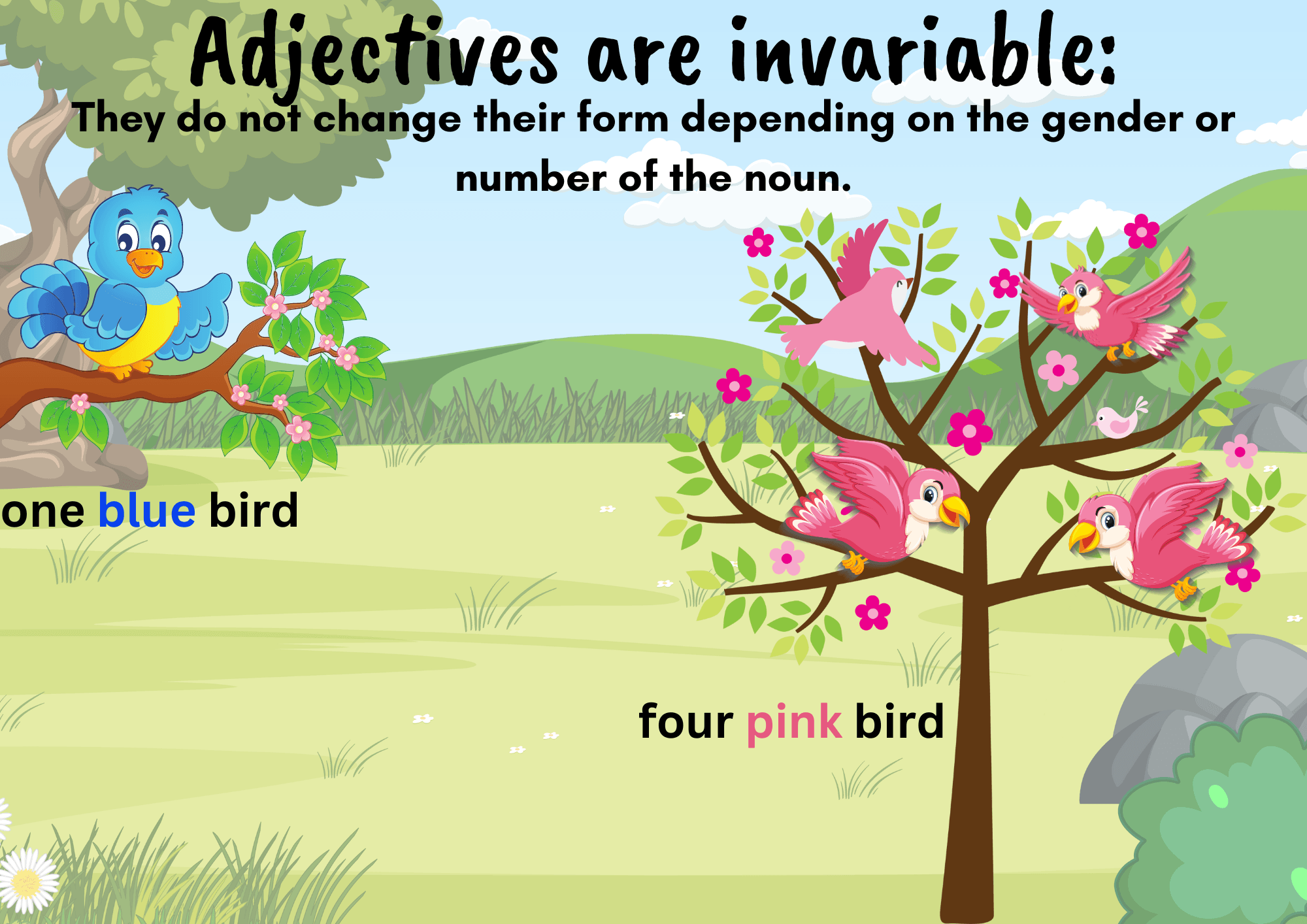
1. Adjectives are invariable:
They do not change their form depending on the gender or number of the noun.
A hot potato
Some hot potatoes
2. To emphasise or strengthen the meaning of an adjective use ‘very‘ or ‘really‘:
A very hot potato
Some really hot potatoes.
Position of adjectives
a) Usually in front of a noun: A beautiful girl.
b) After verbs like “to be”, “to seem” , “to look”, “to taste”:
Examples
- The girl is beautiful
- You look tired
- This meat tastes funny.
c) After the noun: in some fixed expressions:
Examples
- The Princess Royal
- The President elect
- a court martial
d) After the noun with the adjectives involved, present, concerned:
Examples
- I want to see the people involved/concerned (= the people who have something to do with the matter)
- Here is a list of the people present (= the people who were in the building or at the meeting)
Be careful! When these adjectives are used before the noun they have a different meaning:
- An involved discussion = detailed, complex
- A concerned father = worried, anxious
- The present situation = current, happening now
3/12 The order of adjectives
Rules
Where a number of adjectives are used together, the order depends on the function of the adjective.
The usual order is:
Value/opinion, Size, Age/Temperature, Shape, Colour, Origin, Material
Value/opinion
delicious, lovely, charming
Size
small, huge, tiny
Age/Temperature
old, hot, young
Shape
round, square, rectangular
Colour
red, blonde, black
Origin
Swedish, Victorian, Chinese
Material
plastic, wooden, silver
Examples:
- a lovely old red post-box
- some small round plastic tables
- some charming small silver ornaments
This text is already long enough: we’ll stop here. See you on the next post for an interesting Lesson about
COMPARATIVE AND SUPERLATIVE OF ADJECTIVES.
but in the meantime if you to want to become Fluent in English with Active Conversation Lessons
Click here to get access to a repertoire of 120+ video and Quizzes to refine your english
Speaking English fluently is the most important goal. Research shows that fluency is only achieved through repetitive listening comprehension. This course offers "Emphasis Listening", meaning you will listen to a lot of content on the same topic, improving your speaking ability even when you are alone. Increase your talk time to improve your listening skills and understanding. With this course, you can practice anywhere, anytime - while cleaning, cooking, exercising, or even driving to work. The more you use English, the more fluent you will become.